
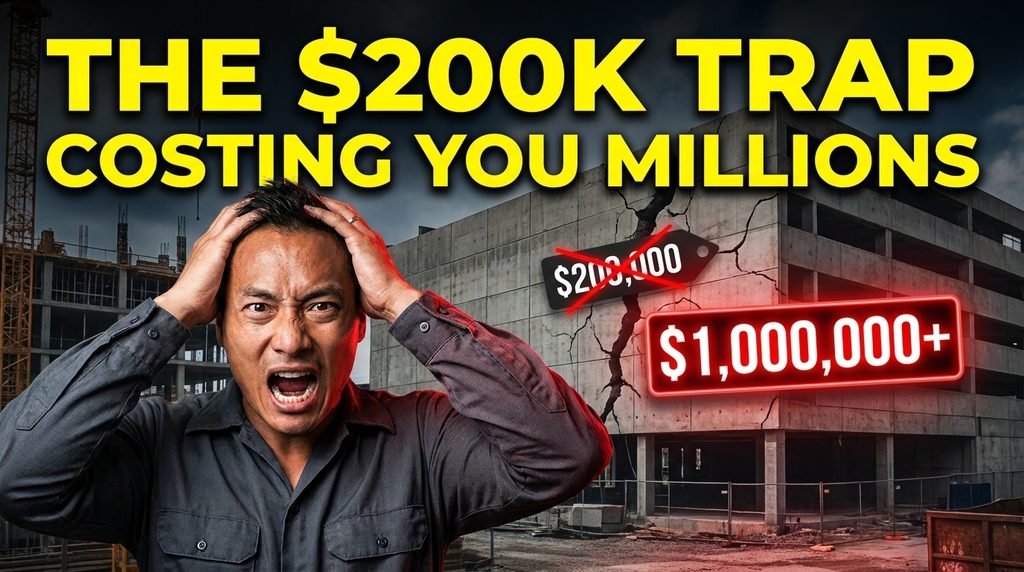
Suppose your Hawaii commercial building needs a $200,000 roof. Most sellers reach the same conclusion: deduct $200,000 from the price and the deal is solved.
Commercial buyers do not underwrite it that way.
In this segment I walk through why deferred maintenance on an Oʻahu or neighbor-island commercial asset almost never trades at repair cost. The buyer is not pricing the roof. The buyer is pricing the uncertainty around the roof — the true project cost, whether the building stays occupied during the work, whether the contractor opens a wall and finds more, whether tenants get disrupted, whether permits are needed, whether the insurance carrier reacts, and whether the lender demands the work be completed before closing. Stack those unknowns and a $200,000 repair routinely creates more than $200,000 of perceived risk.
That risk shows up in more than one place at once. A buyer may reduce your NOI, increase the capital reserve, demand a credit, cut the price, or require a higher return — sometimes all of them in the same offer. This is consistent with the Interagency Appraisal and Evaluation Guidelines, which identify lack of maintenance on a subject property and shifts in capitalization rates among the factors that can change a reported market value.
Some conditions are not cosmetic at all. Roofing, electrical, fire and life safety systems, elevators, sewer, structural issues, environmental conditions, and underground storage tanks each carry their own regulatory weight. Hawaiʻi is a specific example: the Hawaiʻi Department of Health lists July 15, 2028 as the compliance deadline under Hawaiʻi Administrative Rules Chapter 11-280.1, requiring secondary containment for single-walled tanks and piping and interstitial monitoring for release detection on regulated UST systems. Separately, HRS 342L-30(g) places notification obligations on any person selling a UST or UST system.
That is not the kind of discovery you want a buyer making three weeks before closing.
This is why I ask commercial sellers to consider a pre-sale physical review. Not because every problem must be repaired before listing — selling as-is is often the rational play. But selling a known condition strategically and defending an unknown condition mid-escrow are two different transactions with two different outcomes.
Commercial context. Residential sellers in Hawaiʻi still owe a written HRS 508D Seller’s Real Property Disclosure Statement, as-is sale or not.
General real estate commentary only — not engineering, environmental, legal, tax or appraisal advice. Engage licensed contractors, environmental professionals, attorneys, and the appropriate government agencies for any specific property.
Thinking about positioning a Hawaiʻi commercial asset for sale? Let’s talk before you list — not after the buyer’s consultant arrives.
Jason Wong (PB), MBA — President & Principal Broker License #RB-22819 | Island Dragonfly LLC, License #RB-24348
🌐 https://jasonwong.us | 🌐 https://islanddragonfly.com
Serving Oʻahu, Maui, Hawaiʻi Island, Kauaʻi, Molokaʻi and Lānaʻi.
Bilingual English / Chinese for overseas clients. 2022 Global Centurion No. 1 Top Producer, Island of Oʻahu.
📌 Subscribe for weekly Hawaiʻi real estate commentary aimed at owners and investors who want the mechanics, not the marketing.
#HawaiiRealEstate #HawaiiCommercialRealEstate #OahuRealEstate #HonoluluRealEstate #CommercialRealEstate #CREInvesting #DeferredMaintenance #UndergroundStorageTank #USTCompliance #HawaiiDOH #PropertyDueDiligence #SellerDueDiligence #NetOperatingIncome #CapRate #CommercialListing #InvestmentProperty #HawaiiInvestment #IslandDragonfly #JasonWong #PrincipalBroker #HawaiiBroker #1031Exchange #AssetManagement #BuildingInspection #EnvironmentalDueDiligence #PhaseIESA #HawaiiBusiness #RealEstateStrategy
Leave a Reply